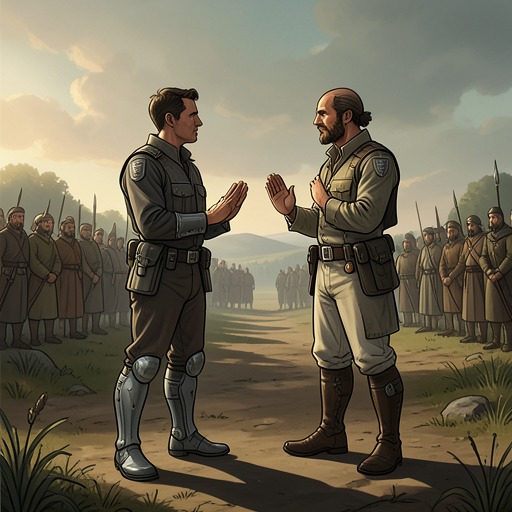
Proposed land agreement between the Lipce peasants and the squire
The PeasantsThe proposed land agreement between the Lipce peasants and the squire turns a conflict over forest rights and livelihood into a fraught negotiation over land. Its promise is tangible: new holdings at Podlesie, linked to the exchange of timber and land. But the offer reaches a village with long memories of injury, scarce work, and broken trust. In the inn, a chalk outline of possible farms briefly makes a different future visible, while the villagers’ arguments reveal how uncertain that future remains.
Causes and Background
The proposal follows a dispute in which the manor’s decisions touch both customary claims and immediate survival. Boryna has insisted that the villagers’ forest rights must be defended, while the manor’s refusal to employ Lipce men for the felling has made the conflict urgent. In winter, hired laborers face frozen potatoes, little or no income, and meals so meagre that some go to bed hungry. Work in the woods had seemed a way to carry them through until spring; exclusion from that work turns the dispute into a crisis of livelihood as well as ownership.
The grievances extend beyond the timber. Villagers have complained that the manor harasses them and that appeals to the courts or the commissioner have brought little relief. Their sense of injustice is grounded in practical claims: land and forest resources matter because they support household survival. Boryna’s own insistence that the woods include land claimed by Lipce, including his four morgen and a morgen associated with Jagna, shows how closely the dispute is bound to individual holdings as well as communal rights.
A second pressure builds around Podlesie. The possibility that German settlers might buy and occupy the estate has prompted talk of collective resistance, including a proposal to approach them together and prevent them from sowing or building if they proceed. The prospect of a settlement with the squire therefore enters a village already weighing rival dangers: continued conflict with the manor, the loss of access to resources, and the arrival of new landholders.
The Offer at the Inn
The proposal is discussed in the inn’s crowded snug, where younger villagers have gathered alongside farmers and elders. Grzela, the Voyt’s brother, explains the terms by chalking them onto the table. The squire has promised each peasant four fields at Podlesie in exchange for one morgen of woodland, with the same amount of land to be released in instalments. He has also offered timber on credit for building cottages. Grzela traces how the land might be divided and what each person could receive, turning a broad promise into a provisional plan that the gathering can inspect.
He presents the offer as a chance to parcel out new farms for Lipce. Yet the villagers do not immediately answer. They study the chalk marks and deliberate, and one elder asks whether the commissioner will permit the arrangement. Grzela argues that community approval should be enough; the question exposes the gap between a proposal made among villagers and an agreement secure against outside authority. The promised appearance of the terms at the notary’s is important for the same reason: the transaction is still prospective, and its security depends on being put into formal written form.
The meeting is not a simple contest between acceptance and refusal. Płoszka warns the others not to trust the squire until the terms are in black and white, arguing that the manor has long profited from the villagers’ wrongs. Kłąb counters that he can oppose the squire when necessary and still support an agreement he believes just for the whole village. Their disagreement is about more than optimism: it asks whether a negotiated benefit can correct an unequal relationship, or whether accepting it risks surrendering the villagers’ leverage.
Division, Persuasion, and Apparent Support
Grzela grows angry when several villagers question the offer, calling them foolish and continuing to explain its advantages. The blacksmith also works to persuade people individually and speaks forcefully in favor of the squire’s honesty. Płoszka remains unmoved, while Kłąb urges him not to obstruct those who might accept. As the argument intensifies, the gathering divides over both the reliability of the offer and the possibility that Lipce could demand more.
The meeting’s tone shifts when Jankiel brings vodka to the table and calls for accord. The farmers drink and debate; by the end of the exchange, all but Płoszka appear inclined toward agreement. The blacksmith repeatedly provides drink and praises the squire, a detail that complicates the show of consensus: persuasion is taking place amid hospitality and celebration, while the blacksmith’s own interest in the arrangement is suspected by the narrator. The noisy conviviality does not erase the earlier caution; it temporarily gives the hopeful side of the argument the upper hand.
What the Proposal Does—and Does Not—Settle
The proposal’s apparent momentum reaches beyond the inn. When asked whether there will be an agreement with the squire, the answer is that there will be one, and that five men have gone to see him that day. The priest welcomes the prospect and offers to say Mass for agreement without payment; he also suggests that the village contribute toward a votive Mass and Exposition. In this response, negotiation becomes both a communal undertaking and an occasion for religious hope. Still, the visit by five representatives marks a further step in talks, not proof that the arrangement has been completed.
The event thus places two kinds of security side by side. The proposed redistribution promises fields, timber, and the possibility of establishing new farms; the villagers’ hesitation insists that promises must be verified and secured. The chalk divisions make the offer concrete enough to imagine, but they cannot settle who has authority over the land or whether the squire will honor the terms. The proposal briefly turns forest conflict toward negotiation, yet the debate preserves the central tension: Lipce needs land and work, and its people have reason to distrust the power offering them.